
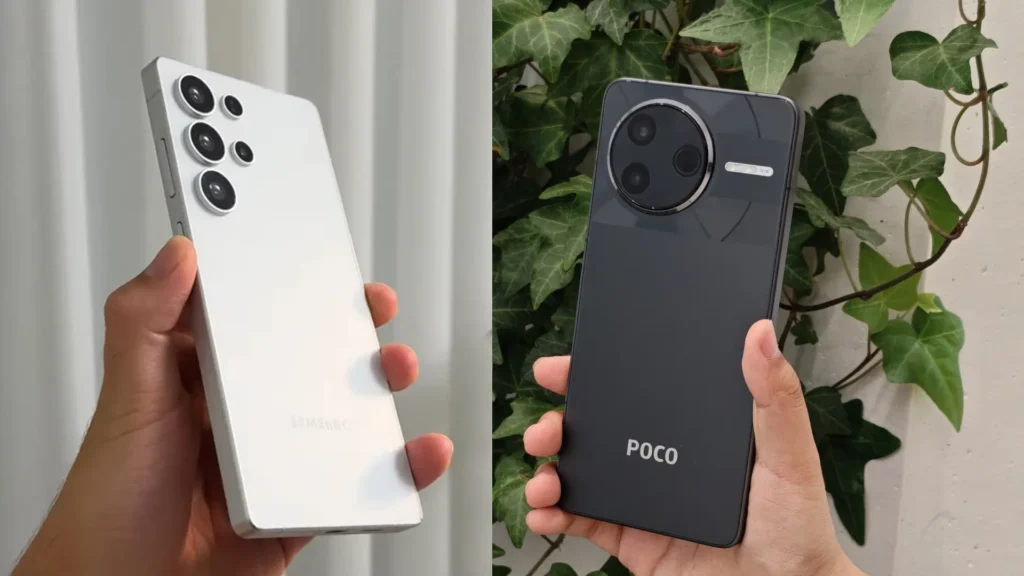
Samsung S25 Ultra vs POCO F7 Ultra: In 2025, choosing a smartphone often feels like picking between a luxury sedan and a turbocharged sports car. Do you splurge on cutting-edge innovation or prioritize raw performance at half the price? The Samsung S25 Ultra and POCO F7 Pro embody this clash, targeting vastly different audiences. One a titanium-clad titan with every bell and whistle, the other a value-focused powerhouse defying its mid-range tag.
But which one truly deserves your wallet? We spent weeks testing both devices, analyzing specs, camera performance, battery life, and real-world usability. This blog post gives you a deep dive unpacks every detail—from AI smarts to gaming stamina—to help you decide.
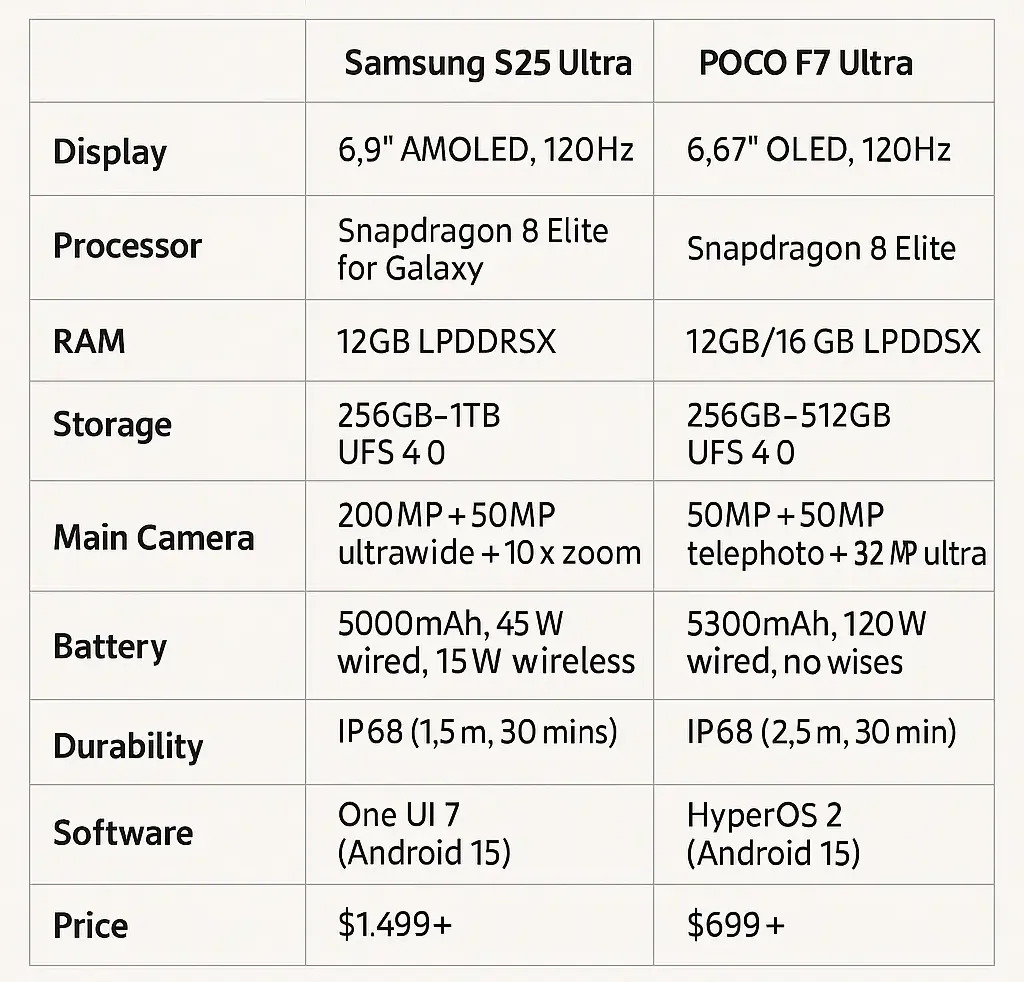
Samsung S25 Ultra vs POCO F7 Ultra: Key Specifications at a Glance
Processor & Performance
The Samsung S25 Ultra flexes its muscles with a custom-tuned Snapdragon 8 Elite chip, earning praise from CNET for “outscoring every flagship in Geekbench 6 benchmarks.” Its AI integration streamlines multitasking, photo editing, and even predictive app launches.
On the other hand, POCO F7 Ultra also leverages the new Snapdragon 8 Elite Chipset—a proven workhorse. PhoneArena notes it “handles daily tasks effortlessly,” while Root-Nation highlights its impeccable performance. For gamers and power users, both models deliver almost same levels of performance.
When it comes to raw benchmarks, the POCO F7 Ultra pulls ahead in AnTuTu (v10) with an impressive score of 2,580,520, compared to the Galaxy S25 Ultra’s 2,207,809. However, in Geekbench (v6), the roles reverse—Samsung takes the lead with a multi-core score of 9,846, edging out POCO’s 8,887.
Samsung’s custom-tuned Snapdragon 8 Elite for Galaxy delivers a more refined performance—especially in AI-driven tasks and real-world usage. Meanwhile, the POCO F7 Ultra shines in synthetic benchmarks, boasting impressive AnTuTu and GeekBench scores. However, for me, the value for money mattered more—and in that regard, the POCO F7 Ultra delivered beyond expectations boasting almost the same chipset inside.
Design & Display
The Samsung Galaxy S25 Ultra and POCO F7 Ultra embody contrasting philosophies in premium smartphone design. The S25 Ultra leans into timeless luxury with a titanium frame and Gorilla Glass Armor 2, offering a sleek, monolithic profile that feels every bit its flagship price tag. Its 6.9-inch Dynamic LTPO AMOLED 2X display dazzles with adaptive 1-120Hz refresh rates and a sustained 2,600-nit brightness, wrapped in Samsung’s signature DX anti-reflective coating for glare-free clarity. While its 218g weight and expansive size demand two-handed use, the IP68-rated titanium build exudes durability, surviving drops and scratches with ease.
In contrast, the POCO F7 Ultra prioritizes practicality without sacrificing flair. Its 6.67-inch Flow AMOLED panel steals the show with a staggering 3,200-nit peak brightness—ideal for sun-soaked environments—and a sharper 526 PPI density, though it trades Samsung’s adaptive refresh for a fixed 120Hz. Where the S25 Ultra opts for premium materials, the F7 Ultra surprises with thoughtful compromises.
Despite a lighter 212g aluminum-and-polymer build, POCO matches Samsung’s IP68 rating and even extends water resistance to 2.5 meters. The matte-finished back resists fingerprints, and the narrower frame enhances one-handed grip, though its plastic camera housing lacks Samsung’s polished titanium accents. Samsung’s display excels in cinematic HDR10+ performance and power-efficient LTPO tech, while POCO counters with Dolby Vision support and a brightness boost that makes outdoor viewing effortless.
Key Takeaways
-
Brightness Wars: POCO’s 3,200-nit display wins for outdoor visibility than Samsung’s full-screen 2,600 nits.
-
Adaptive vs. Fixed Refresh: Samsung’s LTPO tech saves battery during static use; POCO’s 120Hz is smoother for gaming.
-
Durability: Titanium and Gorilla Armor 2 make the S25 Ultra more scratch-resistant, but POCO’s deeper IP68 rating is a surprise.
-
Ergonomics: POCO’s narrower design suits small hands, while Samsung’s heft conveys premium intent.
Who Wins Design & Display?
- Choose the S25 Ultra if: You value adaptive refresh rates, cinematic HDR10+, and titanium luxury.
- Pick the F7 Ultra if: You crave Dolby Vision, extreme brightness, and a lighter, more pocketable form.
Charging & Battery
The Samsung Galaxy S25 Ultra and POCO F7 Ultra take divergent paths in balancing endurance and charging innovation. The S25 Ultra opts for refined efficiency, pairing a 5,000mAh battery with 45W wired and 15W wireless charging. Samsung’s adaptive LTPO display and AI-powered power management ensure all-day stamina, with real-world tests showing 7–8 hours of screen-on time even with 5G and 120Hz enabled. Its wireless charging support integrates seamlessly into Samsung’s ecosystem, topping up Galaxy Buds or Watches in a pinch. However, the 45W wired charging feels conservative in 2025, requiring 58 minutes for a full charge—a trade-off for its premium build and feature set.
The POCO F7 Ultra, meanwhile, redefines speed over subtlety. Its 5,300mAh battery delivers marathon endurance, surviving 10+ hours of screen time and even outlasting the S25 Ultra in continuous video playback (18+ hours in controlled tests). But the star is its 120W HyperCharge—a full 0–100% charge in just 22 minutes, making midday top-ups a non-issue.
POCO sacrifices wireless charging to hit its aggressive price, but the included adapter and smart cooling system ensure blistering speeds without overheating. Gamers and binge-watchers will appreciate the combo of a larger battery and rapid refuels, though the lack of wireless support stings for desk-bound users.
Where Samsung leans on ecosystem polish (reverse wireless charging, adaptive battery optimization), POCO doubles down on raw practicality. The S25 Ultra’s 15W wireless charging caters to luxury convenience, while the F7 Ultra’s 120W wired tech is a lifeline for forgetful chargers. Battery degradation? Samsung’s software promises 95% capacity retention after two years; POCO counters with a bundled charger to minimize third-party adapter wear.
Key Takeaways
- Endurance vs. Speed: Samsung lasts a full day with 30% to spare; POCO’s 120W charging refuels in the time it takes to shower.
- Wireless Convenience: S25 Ultra supports Qi charging and reverse power-sharing; POCO skips it for cost savings.
- Longevity: Both promise 800+ charge cycles, but Samsung’s adaptive charging algorithms edge out POCO.
Who Wins Battery & Charging?
- Choose the S25 Ultra if: You value wireless flexibility, ecosystem integration, and all-day reliability.
- Pick the F7 Ultra if: You prioritize breakneck charging speeds and marathon screen time on a budget.
Camera Performance
The Samsung Galaxy S25 Ultra and POCO F7 Ultra follow different photography philosophies. Each reflects its brand’s market stance.
Samsung Galaxy S25 Ultra
- It uses a 200MP main sensor and a quad-camera array. This setup includes two telephoto lenses (3x and 10x optical zoom).
- Samsung’s AI-powered ProVisual Engine adjusts composition, color balance, and noise reduction.
- In daylight, the 200MP mode captures fine details. You can see individual leaves on distant trees.
- The 50MP ultrawide lens reduces edge distortion. It excels in landscape shots.
- Night Mode combines multiple frames. It brightens shadows without overexposing highlights.
- The Guardian praised its lens versatility. It highlighted the 10x optical zoom for sharp moon shots.
POCO F7 Ultra
- It sports a triple-camera setup: 50MP main, 50MP telephoto (3x optical zoom), and 32MP ultrawide.
- Its computational photography boosts daylight shots. Colors look vibrant and ready for social media.
- Dynamic range can falter. Clouds may blow out in high-contrast scenes.
- The telephoto lens delivers natural bokeh in portraits. Detail fades past 5x zoom.
- Low-light shots can be noisy. Shadows appear muddy.
- Night Mode works but takes 2–3 seconds longer than Samsung’s.
- Android Central called it POCO’s best camera yet, despite mid-range limits.
Feature Comparison
- AI Versatility: Samsung offers Director’s View and AI Object Eraser. POCO has Film Mode filters but fewer pro controls.
- Video: The S25 Ultra films 8K@30fps with strong stabilization. The F7 Ultra tops out at 4K@60fps and shows some jitter.
Key Takeaways
- Detail vs. Vibrancy: Samsung’s 200MP sensor captures more detail. POCO focuses on vivid colors.
- Zoom: The S25 Ultra’s 10x optical zoom wins. POCO’s 3x zoom is decent for close shots.
- Low-Light: Samsung’s Night Mode is faster and cleaner. POCO struggles with noise.
- Video: Samsung’s 8K and AI make it ideal for filmmakers. POCO suits casual vloggers.
Who Wins?
- Choose the S25 Ultra if you need pro-level zoom, top low-light performance, and advanced AI tools.
- Pick the F7 Ultra if you want solid daytime photos and fun filters at half the price.
Software and Features
Samsung Galaxy S25 Ultra: Runs Android 15 with One UI 7, offering a feature-rich experience with deep AI integration. TechRadar notes that Samsung has effectively blurred the lines between Galaxy AI, Bixby system-level AI actions, and Google’s Gemini’s generative AI capabilities. The phone also includes an integrated S Pen for enhanced productivity and creativity.
POCO F7 Ultra: Comes with HyperOS 2, based on Android 15. Notebookcheck mentions that the implemented AI functions are identical to those that can also be found in a Xiaomi 15 Ultra. The phone also features a VisionBoost D7 chipset that optimizes video playback and delivers smoother visuals while gaming.
In this context, both phones are going toe-to-toe. I personally love the software experience on both smartphones. They are no absolute complaints with anything when it comes to software and usability in both smartphones.
Final Verdict: Samsung S25 Ultra vs POCO F7 Ultra
The Samsung Galaxy S25 Ultra is a tour de force for those who refuse to compromise. Its AI prowess, camera versatility, and build quality justify the premium—if you can stomach the cost.
The POCO F7 Ultra redefines value, offering 85% of the experience at half the price. It’s the ultimate choice for gamers, multitaskers, and bargain hunters—provided you can overlook its design and feel. I personally would choose performance over aesthetics every time because its more practical.