
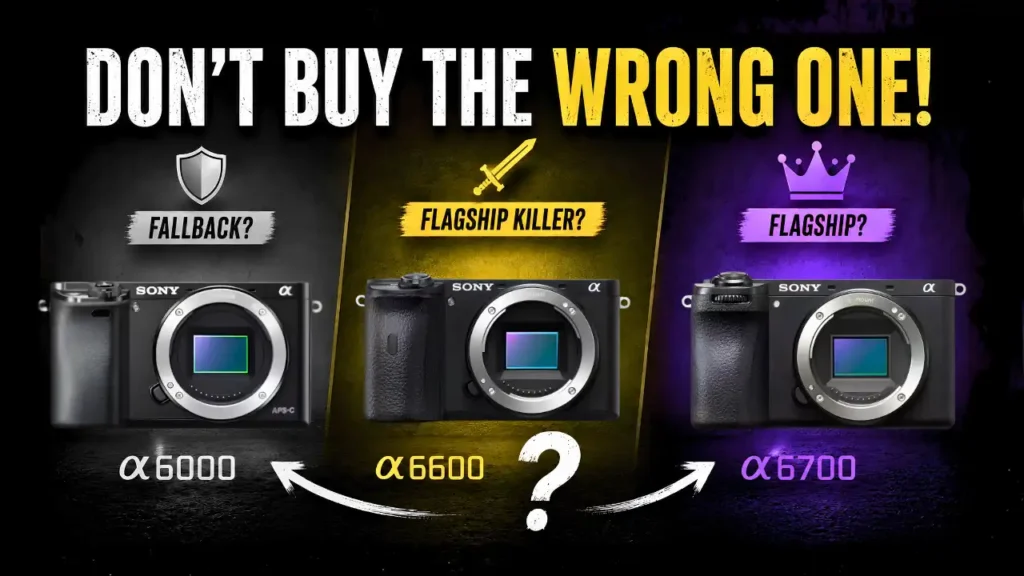
Sony APS-C Cameras: The Flagship, Flagship Killer and Fallback
If you look closely, almost every tech product falls into one of three categories: the Flagship, the Flagship Killer, and the Fallback.
So I wanted to see how that idea works with Sony’s APS-C hybrid camera lineup.
Sony has built one of the most popular APS-C camera systems over the years. From the original Sony a6000 to the newer Sony a6700, there are cameras at almost every price point. But if I had to pick just three cameras for these three categories, which ones would I choose?
And trust me, the answer isn’t as obvious as you might think.
The Flagship: Sony a6700
Let’s start with the Flagship. For me, the answer is the Sony a6700.
Sony has made several excellent APS-C cameras over the years. The a6400 became a favorite among creators, while the a6600 added IBIS and a much larger battery. Even older cameras such as the a6000 and a6500 still have plenty to offer.
So why does the a6700 get the top spot?
Why I Removed the a6400 and a6500
I would remove the a6400 and a6500 first. Not because they are bad cameras. Far from it. But when you’re looking for Sony’s top APS-C hybrid camera, some of their older features start to show their age.
The battery situation is one example. If you’re shooting for long periods, carrying spare batteries can quickly become part of your camera setup.
Trust me, carrying spare batteries around in your pocket is not exactly fun.
That leaves us with the a6600 and a6700.
Why the a6700 Wins
The a6600 came surprisingly close to winning this category. It has IBIS, a large battery, excellent autofocus and a proven track record. For many people, it is still a very capable camera.
However, the a6700 brings two features that I think matter a lot today. The first is AI-powered autofocus. The second is 10-bit video recording.
The second one is especially important if you’re serious about video and color grading. Having 10-bit footage gives you much more room to work with your footage during editing. The newer autofocus system also makes the a6700 a much more modern camera for creators.
Put everything together, and the choice becomes pretty easy for me. If money wasn’t a concern, the Sony a6700 is the APS-C hybrid camera I’d buy. It feels like the most complete camera Sony has made in this lineup.
The Flagship Killer: Sony a6600
Now we get to the category I find much more interesting. A Flagship Killer doesn’t have to be the best camera overall. It needs to get you close to the flagship experience while costing much less.
And that is where the Sony a6600 comes in.
Why the a6600 Almost Won
The a6600 gives you a large part of what makes the a6700 attractive. You get excellent autofocus, IBIS, a large battery and very good hybrid performance.
Depending on what you shoot, I would say you’re getting roughly 80–90% of the overall experience of the a6700.
But there’s one thing that can completely change this decision. Price.
Until around March, my pick for the Flagship Killer was actually the Sony a6400. It offered a lot of what people wanted from a Sony APS-C camera while costing less than the higher-end models.
But things have changed.
Why Price Changes My Pick
The Sony a6600 is now selling much closer to the a6400 than the a6700, based on the prices I’m seeing right now.
And that changes everything. If the a6600 is only a little more expensive than the a6400, the extra features become much easier to justify.
You get IBIS, a much larger battery and a more premium camera without paying anywhere near the price of the a6700.
That’s why, at its current price, the Sony a6600 is my Flagship Killer.
But there’s an important catch. If the a6600 becomes expensive again while the a6400 gets cheaper, I would change my answer. At that point, the a6400 becomes the better deal.
Apart from its smaller battery and lack of IBIS, it still gives you a lot of what makes these cameras so good.
So my Flagship Killer isn’t set in stone. The price decides it.
The Fallback: Sony a6000
Finally, we have the Fallback.
There are quite a few cameras I could have picked here, but my choice is the Sony a6000.
And no, it’s not simply because it’s the cheapest option.
There’s another reason.
Why the a6000 Still Makes Sense
Photography is one of those hobbies that can slowly pull you into a rabbit hole. You don’t just buy a camera.
Soon, you’ll want a better lens. Then an ND filter. A tripod. Extra batteries. Memory cards. A microphone. Lighting.
Before you know it, the camera that was supposed to be an affordable hobby has turned into a very expensive setup.
That’s why I think beginners deserve a camera that lets them discover photography without spending a fortune.
And that’s exactly where the Sony a6000 still makes sense. It’s an old camera by today’s standards, but that doesn’t mean it suddenly became a bad camera.
Even after more than a decade, the a6000 can still produce fantastic images. It also has another big advantage: Sony’s huge E-mount ecosystem.
There are countless lenses and accessories available for the system, along with a massive community of Sony users.
But the biggest reason I like the a6000 as a Fallback is much simpler. It gives you a chance to find out whether photography is actually the hobby for you.
If you love it, you can upgrade later.
And that’s when things get exciting.
Your first camera doesn’t have to be your final camera.
You can start small, learn what you enjoy, figure out what you actually need and then spend more money when you’re ready.
If photography isn’t for you, at least you haven’t spent a fortune finding that out.
That’s exactly why the Sony a6000 is my Fallback.
So, Which Sony APS-C Camera Should You Buy?
For me, the answer depends on what you actually need.
Sony a6700 — The Flagship
If you want Sony’s most capable APS-C hybrid camera and you’re willing to pay for it, the a6700 is the obvious choice.
Its newer autofocus system and 10-bit video make it especially attractive for creators who want a camera they can keep using for years.
Sony a6600 — The Flagship Killer
If the current pricing stays attractive, the a6600 offers a great balance between features and price.
You miss some of the newer technology in the a6700, but you still get a very capable hybrid camera with IBIS and a large battery.
Sony a6000 — The Fallback
If you’re just getting into photography and aren’t sure whether you’re ready to spend serious money, the a6000 is still a great starting point.
It’s affordable, capable and gives you access to Sony’s huge E-mount lens ecosystem.
Sony APS-C cameras: My Final Picks
If I had to make the decision today, these would be my three picks:
Flagship: Sony a6700
Flagship Killer: Sony a6600
Fallback: Sony a6000
But the Flagship Killer comes with one big asterisk.
If the prices change, my answer could change too.
That’s something worth remembering when you’re buying an older camera.
A camera can be an amazing deal at one price and a terrible deal when its price gets too close to a newer model.
And that’s really the point of this whole comparison.
The best camera isn’t always the most expensive one.
Sometimes, the smarter choice is simply the camera that gives you what you need without making you pay for things you don’t.
Sony APS-C cameras: Watch the Full Video
I also made a video breaking down these three categories and explaining why I picked each camera.

I’m also planning to do the same thing with Sony’s video-centric APS-C cameras, so if you’re interested in buying smarter instead of simply buying the most expensive option, keep an eye out for that one.
And now I’m curious.
Do you agree with my picks?
If not, let me know your Flagship, Flagship Killer and Fallback in the comments.
Who knows? You might even change my mind.